Services and Add-Ons: Where Marina Management Software Makes or Breaks the Guest Experience
A berth is the start of a visit, not the whole of it. This is a close look at how marina management software handles services and add-ons: the booking, the pricing, the communication, the internal jobs, the quotes, and why the depth of that handling quietly decides how a stay actually feels.

There is a part of marina management software that gets undersold. Taking a berth booking online is something Moored has done well for a while now, and does reliably. What separates one platform from the next is how it handles the rest of the visit. The extras. The add-ons. The services that turn a place to tie up into a place people talk about on the pontoon at the next harbour along.
I want to walk through what handling services well actually involves, because the distance between a system that lists services and a system that runs them is wide, and it shows up directly in how a guest experiences your marina.
The berth is the doorway, not the room
Think about what a visitor is holding in their head when they arrive. They have somewhere to tie up. Good. Now they want to empty the holding tank, they want to know whether the yard can haul them out at the end of the season, and they would quite like a coffee. In their mind these are not separate businesses. They are all just "the marina."
If your booking system stops at the berth, every one of those needs becomes a phone call, a walk to the office, or a hopeful message left with whoever happens to be on the dock. Each of those is a small tax on the visit. Individually none of them ruins a stay. Together they add up to a place that feels like hard work.
A service catalogue built into the booking system closes that gap. The visitor who booked the berth can browse what else is on offer from the same place they booked, see a real price before they commit, and pay in the same flow. The office is not fielding the same five questions every Friday afternoon. The stay feels looked after, which is the whole game.
A service is only as good as the way it is sold
Marinas offer a genuinely wide spread of things. Utilities. Amenities like showers, laundry and ice. Boatyard work. Parking. Events and berth-holder socials. Concierge requests. Chandlery. Waste and pump-out. That range is exactly why a shallow "list of extras" falls over so quickly. A bag of ice and a full antifoul job have almost nothing in common except that money changes hands.
Moored handles this by giving every service its own home across twelve categories, with a custom option for anything that does not fit a standard box. Each service carries its own description, its own photos, and its own rules for who can see it. A service can be public on your location page, kept internal for staff to sell at the desk, or offered specifically as an add-on when someone books a berth. That last distinction matters more than it sounds, and I will come back to it.
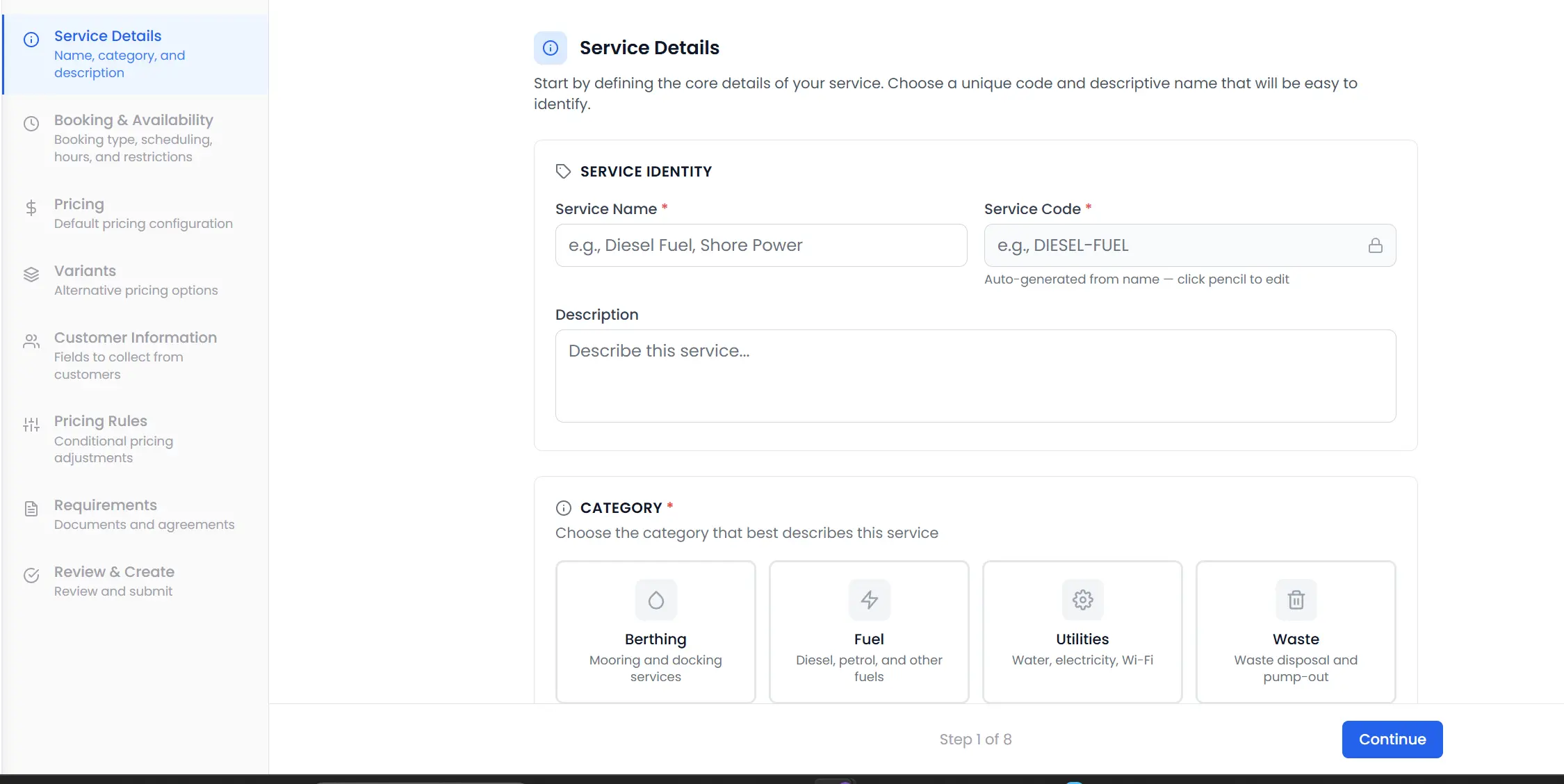
The point underneath all of this is that offering a service and selling it are different jobs. The catalogue is where the selling happens, so it has to carry enough detail that a visitor can make a decision without picking up the phone.
Not every service is bought the same way
Here is where depth starts to separate the serious systems from the rest. A day pass and a rigging job should not travel through the same buying journey, and forcing them to is how marinas end up either underquoting work or scaring customers off a three-pound sale.
Moored gives you five distinct workflows, and the skill is matching the workflow to the service:
- •Instant booking auto-confirms and takes payment on the spot. This is right for the simple, priced-up things: a night of shore power, a bag of ice, a day-visitor pass. No friction, no waiting.
- •Approval required pauses for staff to review before it confirms. A crane slot or a lift-out wants a human eye on the diary before you promise it, and staff can adjust the price before confirming.
- •Quote request lets a customer describe what they need and receive a custom price back. Antifoul, a repair, anything where the number depends on the boat. The customer sets out the job, you send the quote, nobody guesses.
- •Enquiry simply opens a conversation for the services that need a chat before anything is agreed.
- •Staff-only services live at the desk for walk-ins and point-of-sale takings, where the customer is standing in front of you and never touches an online flow at all.
Put the wrong service in the wrong workflow and the guest feels it immediately. Make someone request a quote for a coffee and you have added a day's delay to a two-minute sale. Push a bespoke yard job through instant payment and you have either lost money or landed the customer with a bill that does not match the work. Getting this mapping right is invisible when it works and painfully obvious when it does not.
Pricing that reflects how a marina actually charges
Marina pricing is rarely a flat number, and a system that only understands flat numbers forces you to bend your prices to fit the software. Moored runs sixteen pricing models so the prices bend to fit you instead: per-metre and per-foot of length overall, hourly, daily, weekly, monthly, seasonal and annual rates, tiers based on size or duration or quantity, package deals, quote-based, and free.
On top of that sit conditional rules. A summer surcharge. A weekend rate. A discount for berth holders that a casual visitor does not get. A multiplier once a booking passes a certain quantity. These layer on with a clear priority order, so a berth holder booking a mid-week lift-out in shoulder season lands on exactly the right figure without anyone working it out by hand.
The customer-facing payoff is a real-time price calculator. The visitor sees the actual cost of their length of boat, their dates, their circumstances, before they confirm anything. No surprise on the final screen. That single detail does more for trust than most marinas realise, because the fastest way to sour a stay is a charge that did not match the expectation.
The part that gets forgotten: what happens after "buy"
This is the depth that almost never makes it into a demo, and it is the part that decides whether your extras feel like a service or a hassle.
A service is not finished when the payment clears. A pump-out that has been booked is now a job for the dock team. A lift-out is a slot in the yard's week. A concierge request is a task with someone's name against it. If that sale vanishes into a payment report and never turns into visible work, the customer who paid on Friday is standing on the dock on Saturday wondering why nothing has happened.
Moored keeps the whole thing joined up. Every service sits against the customer and against their booking, on the transaction ledger and in the CRM record, where staff can see what was sold, what state it is in, and what still needs doing. The front desk, the dock team and the yard are looking at the same information rather than three private versions of it. When the visitor asks at the office whether their haul-out is confirmed, the answer is on the screen, not in someone's memory.
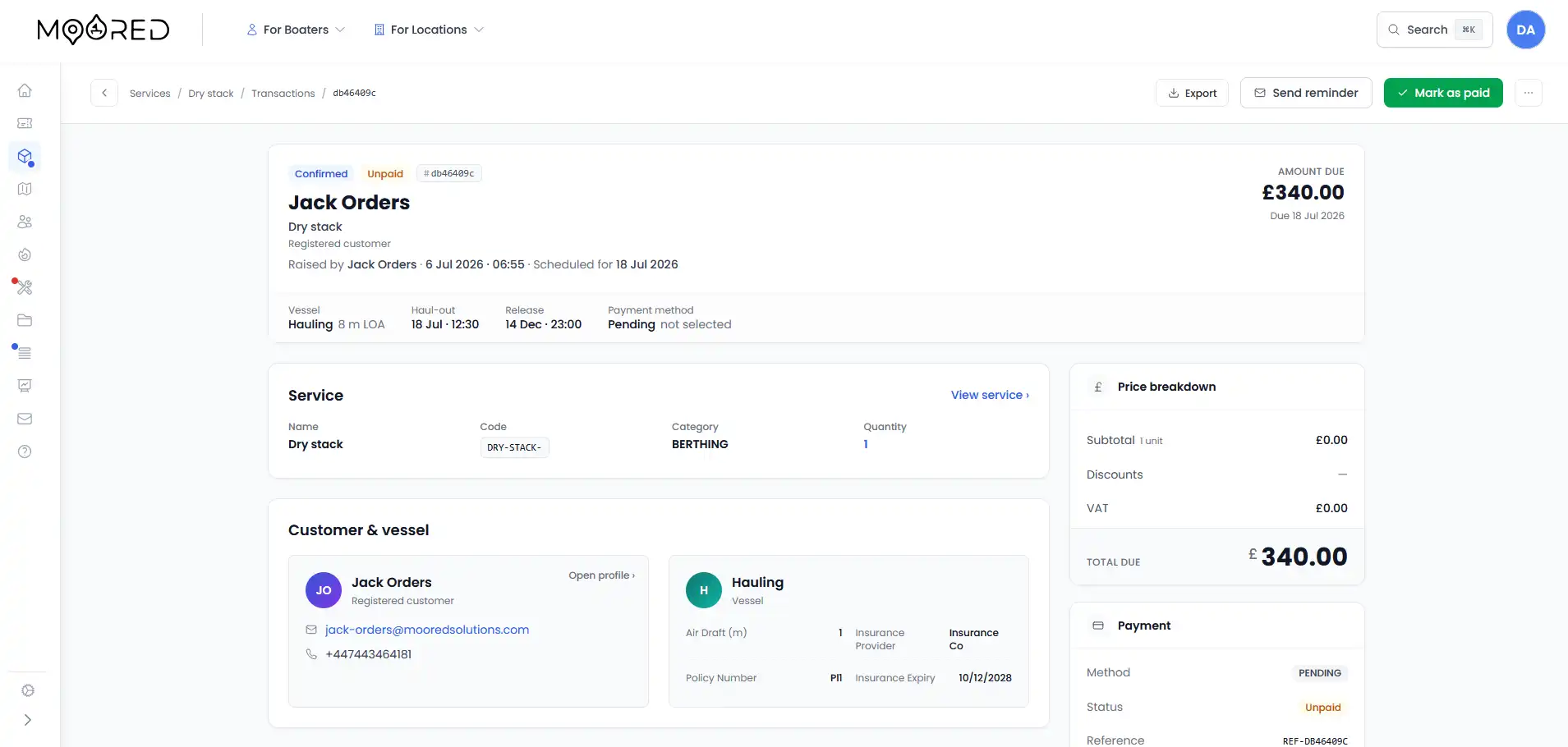
That shared view is the difference between selling a service and delivering one.
Offering the right extras at the moment of booking
There is a specific moment where marinas leave the most on the table, and it is the booking itself. Someone has just committed to a berth. Their attention is on you. That is the ideal instant to put the relevant extras in front of them: shore power, a pump-out on arrival, a parking space for the car.
Because Moored lets a service be flagged as a booking add-on, those extras appear as part of the booking flow rather than as a separate errand the customer has to remember to run later. The visitor arrives already sorted. The dock team already has the jobs on their list. Nobody is chasing anyone.
Depth beats breadth every time
Any system can show you a list of services. Ticking that box is easy, and a lot of platforms tick it. Running services so that the customer, the front desk and the yard all see the same live picture. That is the hard part, and it is the part that actually determines how a stay feels.
The extras are where a marina stops being a car park for boats and starts being a place with a reputation. Get the depth right and the pump-out, the lift-out and the coffee all feel like one looked-after experience. Get it wrong and each of them becomes a small reason not to bother next year.
The berth gets people through the gate. What you do with everything around it is what brings them back.
Moored Solutions includes a full services and point-of-sale system built for harbours and marinas: a twelve-category catalogue, sixteen pricing models, five booking workflows, conditional pricing and live transaction management. See how it works or get in touch to talk through what you offer.
Related Articles
New in Moored: Dry Stack and Hard Standing, Managed Visually
Moored now manages dry stack racks and hard standing visually: a live picture of every space, what is in it, and who it belongs to, sitting alongside the rest of your operation.
Three Messages, Every Boat, Every Time: The Manual Overhead Automation Quietly Removes
There are a handful of messages that turn an average marina stay into one a boater remembers. Sending them to one customer is easy. Sending them to every single customer, personalised, conditional and on time, is a job no person can actually do consistently. That is exactly where the manual process overhead hides, and exactly what automated message streams take off your desk.
The Pros and Cons of Mooring Reservation Systems: Turn Up, Book Instantly, or Request and Wait
There are really only three ways a marina handles an arriving boat: let them turn up and sort it on the day, let them book instantly online, or ask them to request a space and confirm it with staff. Each has a real trade-off, and the honest answer for which one wins depends on your layout, your weather and how busy you get.